
Produktbeschreibung
beschreibung
Physiologische Wirkungen
- Unterstützt die Gesundheit des Magen-Darm-Trakts
- Fördert das Wohlbefinden des Nervensystems
- Trägt zur neuronalen Regeneration und kognitiven Funktion bei
Inhaltsstoffe
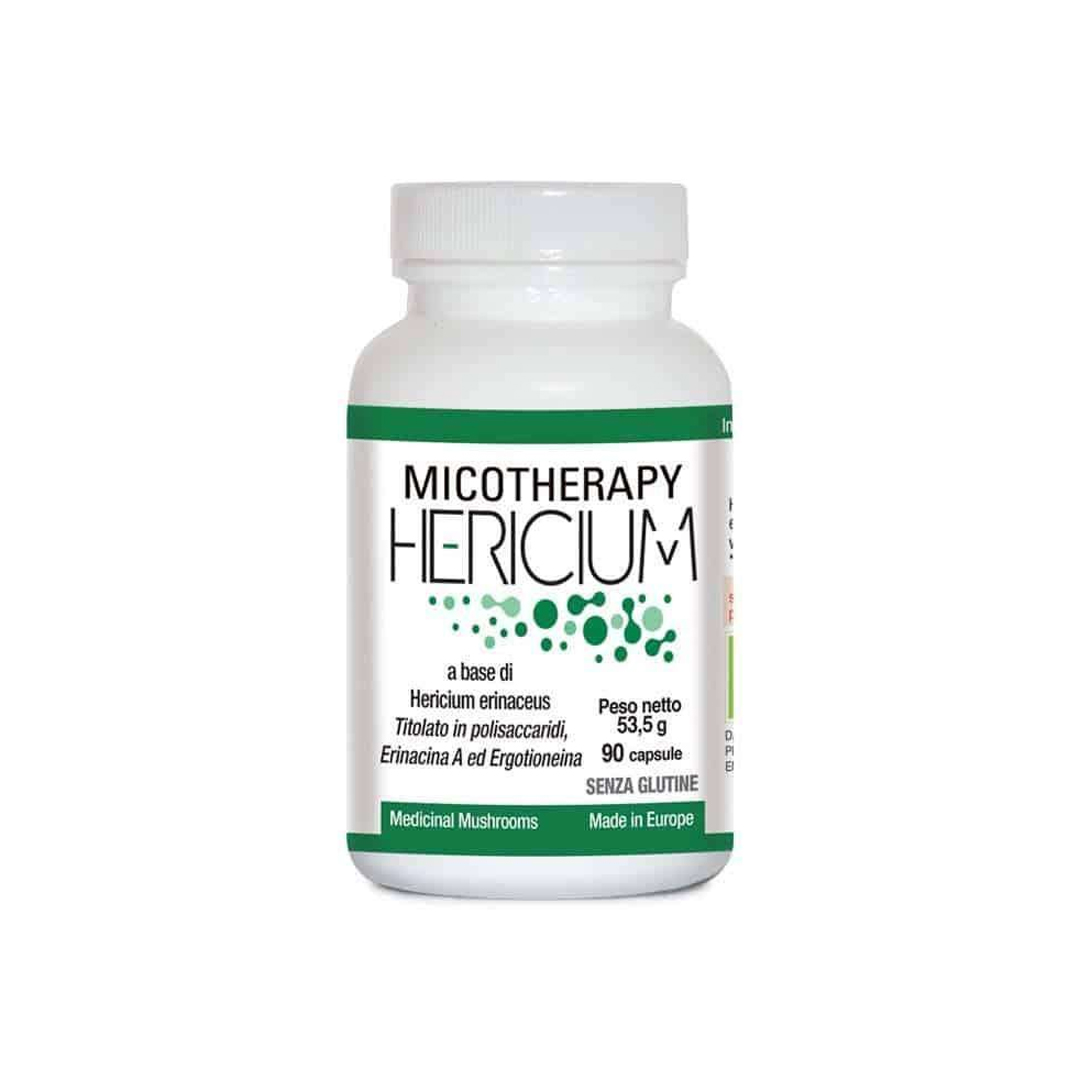
- Hericium erinaceus aus biologischem Anbau, Sporophorum und Trockenextrakt standardisiert auf Polysaccharide, Erinacin und Ergothionein
Enthaltene Substanzen:
- Alle essenziellen Aminosäuren
- Polysaccharide und Glykoproteine
- Hericenone, Erinacine
- Triterpene, Ergosterole, Bioflavonoide
- Alkaloide (Hericenine)
- Fettsäuren
- Mineralstoffe: Kalium, Zink, Eisen, Germanium, Selen, Phosphor
- Ergothionein
| Durchschnittlicher Gehalt der Inhaltsstoffe | pro Tagesdosis (3 Kapseln) |
|---|---|
| Hericium Sporophorum | 1200 mg |
| Hericium Trockenextrakt | 300 mg |
| davon Polysaccharide | 150 mg |
| davon Erinacin A | 417 mcg |
| davon Ergothionein | 346 mcg |
Anwendung
3 Kapseln täglich, vorzugsweise zwischen den Mahlzeiten einnehmen
Format
Packungen mit 30 oder 90 Kapseln
Hinweise
- Glutenfrei
- Ohne Gentechnik (GMO-frei)
- Zutaten aus biologischem Anbau – Made in Europe
- Eingetragen im Nahrungsergänzungsmittelregister: Code 62492
- Paraf-Code: 923588990
- EAN-Code: 8059173430567
Literatur
- K Nagai, A Chiba, T Nishino, T Kubota, and H Kawagishi Dilinoleoyl-phosphatidylethanolamine from Hericium erinaceum protects against ER stress-dependent Neuro2a cell death via protein kinase C pathway. J Nutr Biochem, Aug 2006; 17(8): 525-30
- Kawagishi, H. et al. Hericenones C, D, and E, stimulators of Nerve Growth Factor synthesis, from the mushroom Hericium erinaceum. Tetrahedron Lett. 1991; 32, 4361-4564
- Kawagishi, H. et al. Chromans, Hericenones F, G, and H from the mushroom Hericium erinaceum. Phytochemistry. 1993; 32, 175-178
- Furukawa, S. et al. Biological Significance of Nerve Growth Factor and its Syntheses-Promoting Agent. Chemistry and Biology. 1991; 29. (In Japanese)
- Kawagishi, H. The Basic Chemistry of Mushrooms and Fungus and Biotechnology, Shishido, K. (editor). 2002; IPC, 212-228. (In Japanese)
- Kawagishi, H. Mushroom Yearbook 2002, Efficacy of Mushrooms and its Prospectives. Plants World. 2002; 227-332. (In Japanese)
- Kawagishi, H. Science of Mushrooms, Suguwara, R. (editor). Asakura Shoten. 1997; 155-180. (In Japanese)
- Kawagishi, H. et al. Search for Bioregulating Agents of Edible Mushrooms and Their Performance Analysis, Arai, S. (editor). Gakkai Shuppann Center, 1995; 37-43. (In Japanese)
- Kawagishi, H. et al. Nerve Growth Factor Synthesis-Promoting Agents, Approaches for Studying Vital Function Regulating Agents in Food. Gakkai Shuppan Center, 1996; 165-181. (In Japanese)
- Kawagishi, H. Bioregulating Agents Found in Mushrooms. Food and Development. 2002; 37: 14-17. (In Japanese)
- Kawagishi, H. Bioregulating Agents which Mushrooms Produce. ILSI. 2002; 70: 3-14. (In Japanese)
- Kawagishi, H. The Frontier of the Studies on Functionality of Mushrooms. Science of Food. 2002; 296: 4-12. (In Japanese)
- Kawagishi, H. Bioregulating Agents which Mushrooms Produce, Kinoko-ken Dayori. 2001; 18: 5-14. (In Japanese)
- Kawagishi, H. The Secondary Metabolites of Mushrooms that Promote Synthesis of Nerve Growth Factor. Japan Mycology Journal. 2001; 42: 11-16. (In Japanese)
- Kawagishi, H. Mushrooms are a Mine of Bioregulatory Agents with Unique Backbones and Functions. Chemistry and Biology. 2001; 39: 497-498. (In Japanese)
- Kawagishi, H. The Present Situation of Chemical Study on Functionality of Food. New Food Industry. 2001; 43: 25-35. (In Japanese)
- Kawagishi, H. “Good-For-Body” Agents that Edible Mushrooms Produce. Brain-Tech News. 2000; 81: 1-5. (In Japanese)
- Kawagishi, H. Mushroom-Derived Cellular Function Regulatory Agents. Agriculturization Magazine. 1994; 68: 671-677. (In Japanese)
- Kawagishi, H. et al. The Inducer of the Synthesis of Nerve Growth Factor from Lion’s Mane (Hericeum erinaceum). Explore! 2002; 11(4): 4-51
- Lee. E. W. et al. Two novel diterpenoids, erinacines H and I from the mycelia of Hericium erinaceum. Biosci. Biotechnol. Biochem. 2000; 64: 2402-2405
- Kawagishi, H. et al. Erinacine D, a stimulator of NGF-synthesis, from the mycelia of Hericium erinaceum. Heterocycl. Commun. 1996; 2: 51-54
- Kawagishi, H. et al. Erinacines, E, F, and G, stimulators of nerve growth factor synthesis, from the mycelia of Hericium erinaceum. Tetrahedron Lett. 1996; 37: 7399-7402
- The Anti-Dementia effect of Lion’s Mane mushroom and its clinical application – Hericium erinaceum – Lion’s Mane by Hirokazu Kawagishi Cun Zhuang Ellen Shnidman Townsend Letter for Doctors and Patients, April, 2004 by Hirokazu Kawagishi,Cun Zhuang, Ellen Shnidman
- Kolotushkina, E.V., M.G. Moldavan, K.Y. Voronin & G.G. Skibo, 2003. “The influence of Hericium erinaceus extract on myelination process in vitro.” Fiziologicheskii zhurnal 49(1): 38-45
- Kenmoku, H., T. Shimai, T. Toyomasu, N. Kato & T. Sassa, 2002. “Erinacine Q, a new erinacines from Hericium erinaceum, and its biosynthetic route to erinacines C in the basidiomycete.” Bioscience Biotechnology & Biochemistry Mar; 66(3)571-5
- K Mori, Y Obara, M Hirota, Y Azumi, S Kinugasa, S Inatomi, and N Nakahata Nerve growth factor-inducing activity of Hericium erinaceus in 1321N1 human astrocytoma cells. Biol Pharm Bull, Sep 2008; 31(9): 1727-32
- K Mori, S Inatomi, K Ouchi, Y Azumi, and T Tuchida. Improving effects of the mushroom Yamabushitake (Hericium erinaceus) on mild cognitive impairment: a double-blind placebo-controlled clinical trial. Phytother Res, Mar 2009; 23(3): 367-72
- K Ueda, M Tsujimori, S Kodani, A Chiba, M Kubo, K Masuno, A Sekiya, K Nagai, and H Kawagishi An endoplasmic reticulum (ER) stress-suppressive compound and its analogues from the mushroom Hericium erinaceum. Bioorg Med Chem, November 1, 2008; 16(21): 9467-70
- Moldavan MG, Grygansky AP, Kolotushkina OV, Kirchhoff B, Skibo GG, Pedarzani P. Neurotropic and Trophic Action of Lion’s Mane Mushroom Hericium erinaceus (Bull.: Fr.) Pers. (Aphyllophoromycetideae) Extracts on Nerve Cells in Vitro. IntJMedMushr. Year 2007,Vol. 9 (1): 15-28